
For decades, sustainability in heavy industry was treated as a corporate buzzword – an intention rather than a mechanical reality. But as we navigate through 2026, officially designated as GIIB’s Year of ESG, GIIB Rubber Compound Sdn Bhd (GRC) is fundamentally rewriting that narrative.
We believe that true Environmental, Social, and Governance (ESG) leadership cannot simply be written in a policy document. It must be engineered on the factory floor, tracked through hard data, and proven on the highway.
 A True ESG Perspective on the Tyre Lifecycle
To understand GRC’s impact, we must first look at the lifespan of a commercial tyre through a true ESG lens.
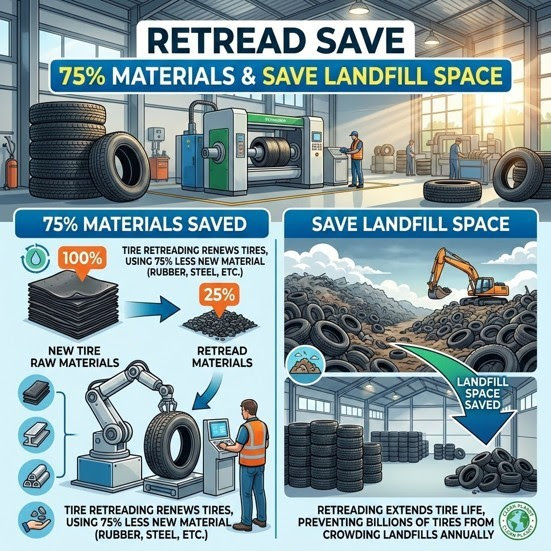
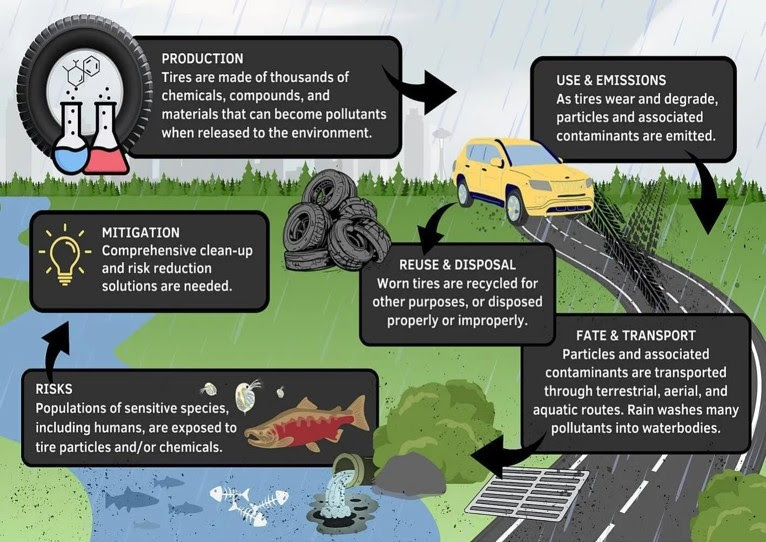
Manufacturing a single new commercial truck tyre consumes roughly 22 gallons of crude oil and requires immense energy output. Historically, a linear economy dictated that once the initial tread wore down, the heavy, resource-dense casing was discardedinto a landfill. From an environmental standpoint, disposing of a structurally viable casing is a catastrophic waste of natural resources.
This is where we at GRC are championing the circular economy. We view the tyre lifecycle not as a straight line to a landfill, but as a continuous, regenerative loop.
A Closed-Loop Vision
Redefining the tyre lifecycle
We move beyond simple recycling to a true circular economy model where resources are recovered and reintegrated.
By engineering premium technical compounds and retreading materials, we enable that original casing to live a second, third, or even fourth life. This circular approach slashes *Scope 3 carbon emissions, drastically reduces raw petroleum consumption, and minimizes industrial waste.
True ESG isn’t just about planting trees; it is about extending the lifecycle of highly engineered assets.
*Scope 3 carbon emissions – all indirect greenhouse gases generated in a company’s wider value chain, spanning both upstream activities (like supply chain and procurement) and downstream activities (like product use and disposal). They are usually the largest component of an organization’s carbon footprint, often exceeding 70-90% of total emissions.
 Driving Measurable ESG Impact at the Factory Level
At GRC, we translate these green intentions into aggressive, measurable industrial impact through strict operational KPIs:
- Environmental (Waste Reduction & Precision): By optimizing our mixing precision and integrating sustainable practices, we are actively keeping viable materials out of the scrap pile. Our aggressive quality control has driven our Year-to-Date (YTD) factory rejection rate down to an incredible 0.38%—meaning maximum material efficiency and minimum industrial waste.
- Social (Workforce Protection): Human capital is the engine of our success. We recently celebrated over 39 consecutive days entirely accident-free, strictly aligning our operations with national PERKESO welfare frameworks and ensuring our people return home safely every single day.
- Governance (Absolute Compliance): We operate with uncompromising transparency. From maintaining DOSH and BOMBA certifications to ensuring our compounds align with global ISO 9001:2015, REACH, and RoHS standards, our governance guarantees a responsible, risk-free supply chain.
Retread to save the world
Reinventing Tyre Life Cycles for a More Sustainable Future
FAST FACTS – The Global Tyre Challenge
- Up to 10 million new tyres used monthly
- High raw material consumption
- Growing environmental waste
With Retreading
- Renew, reuse, recycle tyre casings
- Extend tyre life with precured tread liners
- Reduce dependency on new tyres
Without Retreading
- Continuous demand for new tyres
- Increased carbon footprint
- 3X higher waste generation